Customer service is no longer just about resolving issues. For modern businesses, it is a powerful lever for customer loyalty, expansion, and brand differentiation. Generative AI customer service is accelerating this shift by helping support teams deliver faster, more personalized, and more consistent experiences at scale. From AI-driven customer support examples to improving customer experience with AI call center, this technology is transforming how businesses connect with their clients.
This article explores what generative AI in customer service actually is, how it works in real-world operations, and how you can turn it into a competitive advantage for your organization.
Today, businesses are looking beyond traditional support and embracing tools that make customer interactions smoother and more meaningful. Platforms like FlashMob Computing customer engagement solutions are helping teams streamline their workflow so agents can spend more time addressing real customer needs instead of repetitive tasks. It’s about making every conversation count.
For companies handling large-scale operations, SupercomputerBox AI infrastructure for call centers has become a game-changer. These systems can process huge amounts of data in real time, helping teams anticipate customer needs and respond faster. By combining high-performance computing with intelligent automation, businesses can provide proactive support that feels almost personalized.
Marketing teams are also seeing huge benefits from AI. By following Marketing for Customers strategies to boost engagement, companies can craft campaigns that feel personal while still being efficient. AI insights help fine-tune messaging, timing, and targeting, which increases customer satisfaction and keeps them coming back.
Another way businesses are using AI is through Marketing Runners methods for omnichannel customer communication. These approaches make it easier to coordinate messages across multiple channels while ensuring consistency. By understanding customer behavior, teams can deliver the right message at the right time, creating a seamless experience that feels thoughtful rather than automated.
Finally, it’s important to see the financial upside. Tools like Top Financial Resources guides for cost-efficient customer support show how AI can help reduce costs, improve ROI, and make support operations more sustainable. When used thoughtfully, AI allows businesses to align efficiency with real customer satisfaction, turning every interaction into a meaningful touchpoint.
By bringing all these technologies together, companies aren’t just saving time or money—they’re building stronger, more trusting relationships with their customers. Generative AI customer service isn’t just a buzzword; it’s a powerful tool shaping the future of how businesses connect, assist, and delight their clients.
Top 10 Contact Center Solutions for Generative AI Customer Service
In today’s fast-paced business world, generative AI customer service is revolutionizing how organizations manage customer interactions. From improving efficiency to delivering personalized experiences, AI-driven call center solutions are no longer optional—they’re essential. Here’s a list of the top contact center platforms to help your business stay ahead.
1. Bright Pattern – AI Contact Center Solutions
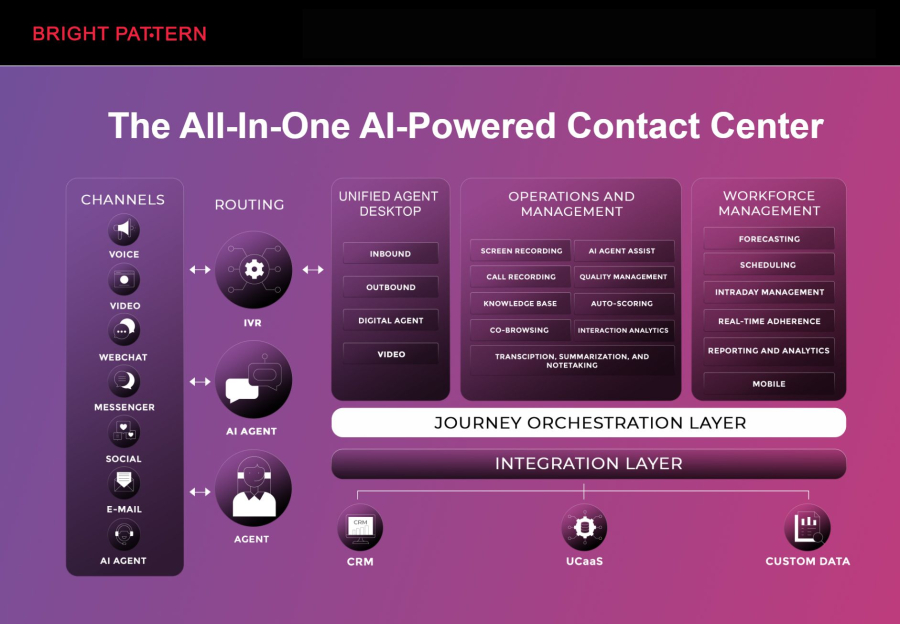
Bright Pattern stands out as a comprehensive solution for organizations looking to integrate AI into their customer service. Its platform enables businesses to deliver consistent, personalized, and fast responses across multiple channels.
Key features include:
- AI-powered chatbots and voice assistants to handle routine inquiries
- Intelligent routing for the right agent at the right time
- Omnichannel support across phone, chat, email, SMS, and social media
- Real-time analytics to monitor performance and improve customer satisfaction
- Integration with CRM and business systems for seamless workflows
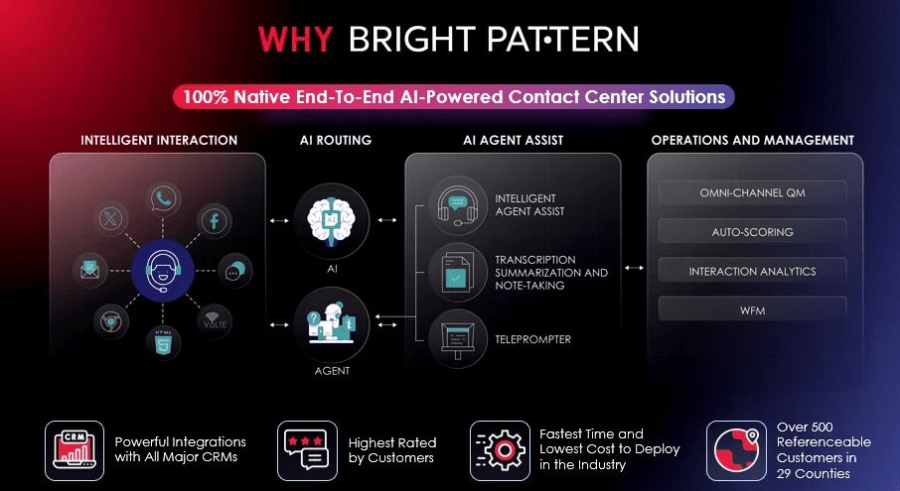
Bright Pattern’s generative AI capabilities allow businesses to predict customer needs, offer proactive support, and reduce agent workload. By using its AI-driven automation, organizations can deliver high-quality service that drives loyalty and efficiency.
2. Genesys Cloud CX
Genesys Cloud CX offers a scalable contact center platform with AI-powered analytics and workforce optimization tools. It’s ideal for businesses looking to unify customer interactions across channels while leveraging predictive insights for better service.
3. Five9 Intelligent Cloud Contact Center
Five9 provides an AI-driven cloud call center solution designed to increase agent productivity and customer satisfaction. Its virtual agents and automation capabilities streamline workflows and reduce handling time.
4. NICE inContact CXone
NICE inContact CXone is a cloud-based contact center platform that combines AI, analytics, and workforce management to deliver a seamless customer experience. It enables smart routing and omnichannel communication.
5. Talkdesk AI Contact Center
Talkdesk uses AI to optimize call center operations with features like sentiment analysis, predictive routing, and virtual agents. Its platform focuses on improving efficiency and customer engagement simultaneously.
6. Zendesk AI-Powered Support
Zendesk provides a flexible customer service platform with AI capabilities for automated responses, ticket management, and knowledge base integration, allowing agents to focus on complex inquiries.
7. Cisco Contact Center AI Solutions
Cisco’s AI contact center offerings provide virtual agents, natural language processing, and predictive analytics to enhance agent performance and customer satisfaction in large-scale operations.
8. Avaya OneCloud CCaaS
Avaya’s cloud contact center solution integrates AI-driven automation, analytics, and omnichannel support. It focuses on improving agent efficiency while delivering personalized customer experiences.
9. 8x8 Contact Center
8x8 offers an AI-enabled cloud contact center with real-time analytics, intelligent routing, and multichannel communication capabilities. It helps businesses reduce call times and increase resolution rates.
10. RingCentral Contact Center
RingCentral provides an AI-powered contact center solution that supports voice, chat, email, and social interactions. Its automation tools improve response times and overall customer satisfaction.
What Is Generative AI in Customer Service?
Generative AI in customer service refers to AI systems that can understand natural language, generate human-like responses, and assist both customers and support agents across channels such as chat, email, messaging, and even voice.
Unlike traditional rule-based chatbots that rely on rigid scripts and decision trees, generative AI can:
- Understand intentin flexible, conversational language rather than specific keywords only.
- Generate responsesthat are context-aware and tailored to each customer and situation.
- Leverage knowledge sourcessuch as FAQs, help centers, product documentation, and past tickets.
- Learn and improveover time as you refine prompts, policies, and training data.
The result is a new kind of support experience in which AI handles a large portion of repetitive tasks, and human agents focus on complex, high-value conversations.
Why Generative AI Is a Game-Changer for Customer Support
When implemented thoughtfully, generative AI transforms customer service from a reactive cost center into a proactive, scalable growth engine. Here is how.
1. Instant, 24/7 Support Without Burning Out Your Team
Customers expect fast, always-on support. Generative AI enables you to offer:
- Round-the-clock coverageacross time zones and holidays.
- Near-instant first responsesfor chat and messaging channels.
- Lower wait timesduring peak periods without hiring surges.
This responsiveness reduces frustration, prevents ticket backlogs, and creates a smoother experience from the very first interaction.
2. Hyper-Personalized Customer Experiences
Generative AI can tailor responses based on customer history, preferences, and context. When connected to your CRM or customer data, it can:
- Recognize returning customers and reference past interactions.
- Adapt tone and detail level based on customer profile or channel.
- Provide recommendations and next-best actions that fit each customer journey.
This level of personalization makes customers feel understood and valued, which directly supports loyalty and retention.
3. Consistent, On-Brand Answers Every Time
Human agents naturally have different communication styles. Generative AI helps align responses with your brand voice and policies by:
- Usingpredefined tone and style guidelinesin its prompts.
- Pulling fromcentralized knowledge basesfor accurate, approved information.
- Applyingstandard workflows and policiesreliably across every interaction.
The result is a more predictable, professional experience for customers and fewer inconsistencies that can otherwise lead to confusion or escalations.
4. Scale Support Without Proportionally Growing Headcount
As your customer base grows, support volume usually grows with it. Generative AI helps you decouple these two curves by:
- Automating routine questions such as order status, account details, returns, or basic troubleshooting.
- Drafting high-quality responses for agents to review instead of writing from scratch.
- Reducing average handling time for both simple and moderately complex tickets.
This means you can serve more customers with the same team size, while agents focus on conversations where human judgment and empathy matter most.
High-Impact Use Cases of Generative AI in Customer Service
Generative AI can touch nearly every part of the support journey. Below are some of the most impactful and achievable use cases.
AI-Powered Self-Service Assistants
One of the most visible applications is the AI assistant embedded in your website, app, or portal. These assistants can:
- Answer questions in natural language rather than forcing users into rigid flows.
- Guide customers step by step through processes such as onboarding or returns.
- Surface relevant help articles or forms dynamically based on the conversation.
- Escalate to a human seamlessly when needed, with full context handed over.
Effective self-service does not just deflect tickets; it helps customers get quick, confident answers on their own terms.
Agent Assist and AI Co-Pilots
Generative AI is also a powerful companion for human agents working behind the scenes. An AI co-pilot can:
- Suggest repliesbased on customer messages, policies, and knowledge base content.
- Summarize long conversationsso agents grasp context at a glance.
- Surface relevant internal documentationright when agents need it.
- Translatemessages across languages while preserving intent and tone.
This reduces cognitive load, speeds up response times, and shortens the time it takes to onboard new agents to full productivity.
Smart Knowledge Base Creation and Maintenance
Support content is the foundation of good customer service, but it is time-consuming to create and maintain. Generative AI can help by:
- Drafting help center articles from product documentation or internal notes.
- Summarizing complex procedures into clear, step-by-step guides.
- Suggesting updates when policies, prices, or product features change.
- Identifying content gaps based on recurring questions and ticket trends.
With AI as a content partner, your knowledge base stays fresher, clearer, and more aligned with real customer needs.
Proactive Support and Customer Retention
Beyond reactive support, generative AI can help you act before customers even ask for help. For example, AI can assist with:
- Drafting proactive outreach when there is a known issue or product update.
- Creating personalized tips to help customers get more value from your product.
- Composing retention messages when customers show signs of churn risk.
- Following up on resolved tickets with tailored check-ins or survey invitations.
This proactive layer strengthens relationships and turns support into an engine for long-term satisfaction and expansion.
Real-World Outcomes Support Teams Commonly Achieve
Organizations adopting generative AI in customer service often report improvements across multiple dimensions. While results vary by industry and implementation, common outcomes include:
- Shorter response and resolution timesas AI handles initial triage and routine questions.
- Higher customer satisfaction scoresdriven by faster, clearer, and more consistent answers.
- Reduced ticket volume per customeras self-service experiences become more effective.
- Higher agent productivity and engagementthanks to AI assistance with drafting, summarizing, and research.
- More scalable operationsthat can support growth without constant hiring pressure.
These results compound over time, turning support into a strategic asset rather than a purely operational function.
How Generative AI Fits Into Your Existing Support Stack
Generative AI is most effective when it is integrated into the tools and workflows you already use. Typical touchpoints include:
- Live chat and messagingplatforms, where AI can handle first-line interactions or assist agents during conversations.
- Email support systems, where AI drafts replies, suggests templates, and categorizes incoming messages.
- Ticketing and help desk platforms, where AI can prioritize tickets, summarize issues, and propose next steps.
- Knowledge bases and documentation, which AI uses as a source of truth and helps keep up to date.
- CRM systems, where AI accesses customer history to personalize responses and recommendations.
By connecting generative AI to these systems, you create a unified, intelligent support ecosystem rather than yet another isolated tool.
A Practical Roadmap to Implement Generative AI in Customer Service
Moving from interest to impact requires a structured approach. Below is a practical roadmap you can adapt to your organization.
Step 1: Clarify Objectives and Success Metrics
Start with clear goals. Examples include:
- Reducing average first response time for chat or email.
- Increasing self-service resolution rate.
- Improving customer satisfaction or net promoter scores for support interactions.
- Shortening onboarding time for new agents.
Define a small set of measurable outcomes so you can clearly demonstrate value and secure long-term support for the initiative.
Step 2: Audit Your Content and Data
Generative AI performs best when it has high-quality information to draw from. Conduct a quick audit of:
- Existing FAQs, help articles, and macros.
- Product documentation, release notes, and internal guides.
- Historical tickets that show how issues are actually resolved.
Identify which content is up to date, what needs refreshing, and where there are gaps. This foundation will significantly influence AI accuracy and usefulness.
Step 3: Pick One or Two High-Impact Use Cases to Pilot
Instead of trying to automate everything at once, start focused. Common pilot candidates include:
- An AI assistant for a specific queue, such as pre-sales questions or order tracking.
- Agent assist for one channel, such as drafting email responses.
- AI-generated summaries for chat or phone call notes.
Choosing a narrow, high-impact scope helps you deliver quick wins, learn from real interactions, and build internal confidence.
Step 4: Design Guardrails, Tone, and Escalation Rules
Careful configuration is key to trustworthy AI. Define:
- Tone and style guidelines, such as being friendly, concise, and solution-focused.
- Topics AI can handle autonomouslyversus those that must go directly to a human.
- Escalation triggers, for example sensitive billing issues or signs of customer distress.
- Approval workflowsfor AI-generated content that needs review, such as refunds or exceptions.
These guardrails ensure that AI augments your team while respecting brand, policy, and customer expectations.
Step 5: Train, Test, and Refine
Before a broad rollout, run controlled tests with real but limited traffic. During this phase:
- Monitor AI conversations closely for accuracy, clarity, and tone.
- Collect feedback from agents who use AI assistance in their daily work.
- Refine prompts, knowledge sources, and rules based on what you learn.
Iterative refinement quickly improves performance and builds trust among both customers and internal teams.
Step 6: Launch, Measure, and Scale
Once you are confident in quality, expand your AI deployment gradually:
- Roll out to more channels or regions.
- Broaden the set of topics AI can handle end to end.
- Introduce additional capabilities such as proactive outreach or advanced analytics.
Continue to measure results against your original goals, and use those insights to guide further investment.
Best Practices for High-Performing Generative AI Support
To get sustained value from generative AI in customer service, consider the following best practices.
Keep Humans in the Loop
Generative AI is most powerful when it augments, not replaces, human expertise. Maintain a strong human-in-the-loop approach by:
- Allowing agents to edit AI-drafted responses before sending.
- Enabling easy escalation from AI to human agents during customer conversations.
- Using agent feedback to fine-tune prompts and improve AI suggestions.
This combination delivers both efficiency and the empathy that only humans can fully provide.
Invest in Knowledge Quality
AI is only as good as the knowledge it can access. Make it a priority to:
- Regularly update articles, macros, and policy documents.
- Standardize terminology and naming conventions across your documentation.
- Archive or clearly mark outdated content so AI does not use it.
High-quality, well-structured information dramatically increases the accuracy and reliability of generative AI responses.
Design for Your Brand Voice
Your customer service is a direct expression of your brand. Encode your voice into AI behavior by:
- Defining clear tone characteristics such as friendly, professional, or playful.
- Providing sample responses that demonstrate the desired style.
- Regularly reviewing AI conversations for alignment with your brand personality.
Consistency in voice builds trust and helps your brand stand out in crowded markets.
Prioritize Transparency with Customers
Customers are generally comfortable with AI as long as you are transparent and helpful. You can:
- Clearly indicate when they are interacting with an AI assistant.
- Offer an easy pathway to speak with a human at any time.
- Use plain language to explain what AI can and cannot do.
This openness encourages adoption and reduces confusion or frustration.
Key Metrics to Track When Using Generative AI in Support
To understand the true impact of generative AI on customer service, monitor metrics across efficiency, quality, and customer experience.
Operational and Efficiency Metrics
- First response timefor each channel.
- Average handling timeper ticket or conversation.
- Agent capacity(tickets handled per agent per day).
- Deflection and self-service resolution rate.
Customer Experience Metrics
- Customer satisfaction scoresfor AI-assisted interactions.
- Resolution rateon first contact.
- Retention and renewal ratesfor supported customers.
- Qualitative feedbackfrom surveys and open comments.
Team Experience and Quality Metrics
- Agent satisfaction and engagementwith AI tools.
- Onboarding timefor new agents to reach target productivity.
- Rate of manual overridesof AI suggestions, which can signal training opportunities.
By reviewing these metrics regularly, you can spot opportunities to refine prompts, expand use cases, or adjust workflows for even better outcomes.
The Future of Customer Service with Generative AI
Generative AI is already reshaping customer service, and its capabilities are advancing quickly. Over time, you can expect to see:
- More natural, multi-turn conversationsthat feel closer to human dialogue.
- Tighter integration with product usage data, enabling context-aware support directly within your app.
- Smarter, more targeted automationsacross support, success, and sales teams.
- Deeper collaborationbetween AI and human agents, with AI taking on more of the heavy lifting behind the scenes.
Organizations that start building their AI-powered support capabilities now will be best positioned to benefit from these advances.
Conclusion: Turn Support into a Strategic Advantage with Generative AI
Generative AI gives customer service teams a powerful new toolkit. By combining natural language understanding, flexible response generation, and deep integration with your knowledge and systems, it allows you to:
- Serve customers faster and more consistently.
- Deliver personalized, proactive support at scale.
- Empower agents with intelligent assistance instead of repetitive work.
- Convert customer service from a cost center into a driver of loyalty, retention, and growth.
With a clear strategy, strong guardrails, and a focus on both customer and agent experience, generative AI in customer service can become one of your most valuable competitive advantages.
The organizations that win in the next era of customer experience will be those that pair the empathy and creativity of humans with the speed and scale of AI. Generative AI is your opportunity to build that future today.
